Hidden among limestone formations in Halong Bay, Tien Ong Cave offers a perspective that goes beyond natural beauty. While many caves in the region attract visitors with dramatic stalactites and lighting effects, this cave stands out for its connection to human history. Layers of stone and silence here tell stories of early settlement, survival, and adaptation.
Rather than functioning solely as a scenic stop, Tien Ong Cave represents a place where nature and human presence intersected thousands of years ago. Archaeological findings have revealed traces of prehistoric life, turning the cave into a cultural site as much as a geological one. Because of this dual identity, visiting the cave feels reflective rather than spectacular.

1. The Historical Significance of Tien Ong Cave
The importance of Tien Ong Cave lies not in decoration, but in evidence. Long before tourism reached Halong Bay, humans used this cave as a place of shelter and daily activity. Archaeological discoveries have confirmed that early communities occupied the cave thousands of years ago, adapting to the coastal environment around them.
A Shelter for Early Coastal Communities
Archaeologists have uncovered tools, shells, and traces of cooking inside the cave. These findings suggest that prehistoric people used the space regularly rather than temporarily. The cave provided protection from weather while remaining close to water sources and marine food.
Because of its elevated position, the cave allowed inhabitants to observe surroundings easily. This advantage supported both safety and resource gathering. Over time, repeated use transformed the cave into a stable living environment.
Key evidence found inside includes:
- Stone tools used for daily tasks
- Shell remains from marine consumption
- Signs of fire and cooking activity
- Spatial organization indicating long-term use
These discoveries confirm that the cave functioned as more than a refuge.
Understanding Human Adaptation Through the Cave
Tien Ong Cave helps explain how early communities adapted to coastal life. Instead of settling permanently on open land, people used caves to balance protection and access. This strategy allowed survival in changing conditions.
The cave’s location reveals careful choice rather than chance. Proximity to the sea supported food supply. Limestone structure provided insulation. Natural light entered without exposing inhabitants fully. These factors combined to create a sustainable living space.
Why This History Still Matters
The archaeological value of Tien Ong Cave adds depth to the Halong Bay experience. It reminds visitors that the landscape supported human life long before modern exploration.
By preserving these traces, the cave connects present visitors to ancient routines. Walking through the space encourages reflection on continuity rather than novelty. The cave does not display history loudly. Instead, it holds it quietly within stone and shadow.
Through its historical significance, Tien Ong Cave stands as a cultural landmark. It expands understanding of Halong Bay beyond scenery, revealing a place shaped by human presence across time.
2. Geological Features and the Natural Structure of Tien Ong Cave
The physical structure of Tien Ong Cave reflects millions of years of geological change shaped by water, wind, and time. Rather than impressing visitors with dramatic scale alone, the cave reveals its character through layered formations and subtle transitions. This section explores how natural processes created the cave’s interior and how these features supported both environmental balance and human use.

Limestone Formation and Cave Development
Tien Ong Cave formed within limestone cliffs that dominate Halong Bay’s landscape. Over long periods, rainwater and seawater slowly dissolved the rock, carving out chambers and corridors. As a result, the cave developed a stable interior protected from external erosion.
Unlike caves with sharp drops or narrow tunnels, this cave features wide spaces that allow steady movement. The floor remains relatively even, which made the cave suitable for long-term human presence. Natural openings also allowed airflow, preventing moisture from becoming excessive.
Several geological characteristics define the cave’s structure:
- Thick limestone walls providing insulation
- Wide chambers shaped by gradual erosion
- Natural slopes instead of sudden changes in height
- Openings that balance light and ventilation
Together, these features create a space that feels calm rather than dramatic.
Stalactites, Stalagmites, and Subtle Detail
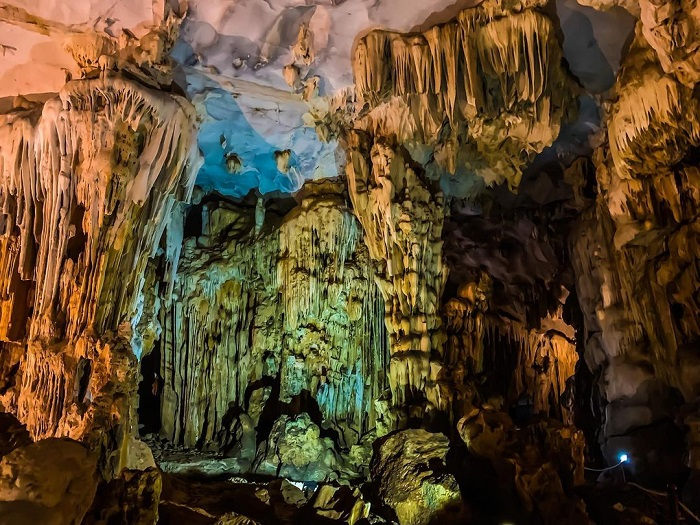
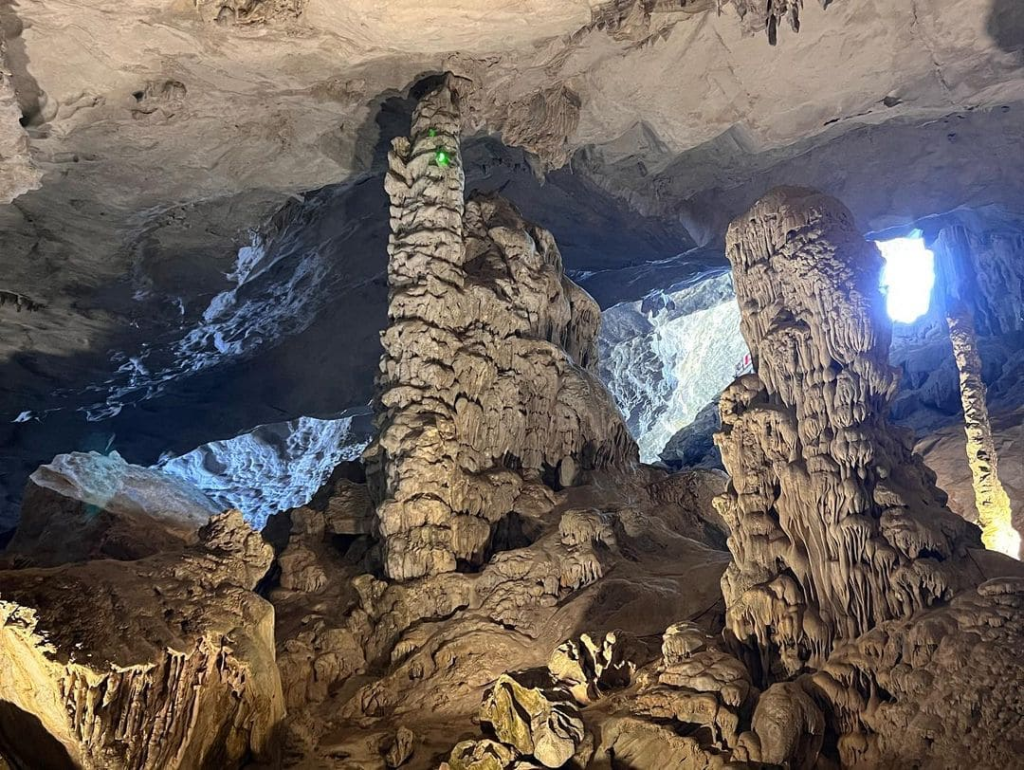
Inside Tien Ong Cave, stalactites and stalagmites appear in modest clusters rather than dense formations. Their shapes vary, formed by mineral-rich water dripping over centuries. Instead of dominating attention, these formations contribute texture and depth.
Because growth occurred slowly and evenly, the cave avoided extreme density. This balance preserved visibility and movement. Visitors can observe details without obstruction, allowing appreciation through quiet observation.
Importantly, formations remain undisturbed. Conservation efforts limit artificial lighting and physical contact. As a result, the cave maintains its natural tone rather than becoming theatrical.
Light, Space, and Environmental Balance
Natural light enters the cave through carefully positioned openings. This light shifts throughout the day, creating soft changes in atmosphere. Shadows move gradually. Surfaces reveal different textures over time.
This lighting pattern supported early human activity. Visibility remained sufficient without full exposure. At the same time, the cave stayed cool and protected.
Environmental balance continues today. Temperature stays consistent. Humidity remains controlled. These conditions protect both geological features and archaeological evidence.
Why Structure Matters to Cultural Understanding
The natural structure of Tien Ong Cave explains why humans selected it as a living space. Stability mattered. Accessibility mattered. Environmental comfort mattered.
Geology did not simply create a scenic cave. It created a functional shelter. This relationship between natural form and human adaptation adds meaning to the visit.
By understanding the cave’s geological features, visitors gain deeper insight into how environment shapes behavior. Tien Ong Cave stands as an example of how natural structure can support life quietly and effectively across generations.
3. Tien Ong Cave Within Halong Bay’s Cultural Landscape
Tien Ong Cave holds cultural meaning because it exists as part of a broader human landscape rather than as an isolated site. While Halong Bay is often viewed through its natural scenery, this cave adds an important human dimension. It shows how people once interacted with the environment and how that relationship shaped early coastal culture.
A Cave Connected to Daily Survival
The cultural value of Tien Ong Cave comes from its role in everyday life rather than ritual or ceremony. Archaeological evidence suggests that people used the cave as a practical living space. Activities such as cooking, tool-making, and food preparation happened regularly inside.
This daily use places the cave within a network of coastal activity. Early communities relied on the sea for food and used nearby landforms for shelter. The cave supported this lifestyle by offering safety without separation from resources.
Several aspects highlight this connection:
- Proximity to fishing and marine harvesting areas
- Easy access from water routes
- Natural protection without isolation
- Visibility over surrounding landscape
These features allowed the cave to function as part of a larger living system.
Human Presence Shaping Cultural Identity
Tien Ong Cave reflects how early inhabitants understood their environment. Instead of altering the landscape, they adapted to it. This approach shaped cultural identity based on balance and restraint.
The cave shows evidence of organization. Spaces inside were likely used for specific tasks. Fire areas stayed controlled. Movement followed natural contours. These behaviors suggest awareness of long-term use rather than temporary occupation.
This cultural pattern aligns with other archaeological sites in Halong Bay. Together, they indicate a lifestyle centered on adaptation rather than domination.
From Living Space to Cultural Heritage
Over time, the role of Tien Ong Cave changed. As communities evolved, the cave shifted from a living space to a historical record. Today, it stands as a reminder of human continuity in Halong Bay.
Modern visitors experience the cave differently. They walk slowly. They observe quietly. Interpretation replaces survival. However, the space still encourages reflection rather than excitement.
Cultural preservation efforts respect this tone. Signage remains minimal. Lighting stays subtle. Pathways follow natural lines. These choices protect both meaning and material.
Why Cultural Context Deepens the Visit
Understanding the cultural context transforms the experience of Tien Ong Cave. Instead of focusing only on formation, visitors consider human stories embedded within stone.
This perspective adds depth to Halong Bay as a destination. It shifts attention from spectacle to understanding. It reminds visitors that beauty and history coexist.
Tien Ong Cave contributes quietly to this narrative. Through its cultural landscape, it bridges nature and humanity. The cave stands not only as a geological feature, but as a witness to how people once lived within Halong Bay’s environment.
4. Visiting Tien Ong Cave Today: Experience and Preservation
Visiting Tien Ong Cave today offers a calm and reflective experience rather than a dramatic one. The cave invites visitors to move slowly, observe carefully, and consider its layered meaning. This section explores what the visit feels like now and how preservation efforts protect both cultural and natural value.

A Quiet and Respectful Visitor Experience
The visit to Tien Ong Cave unfolds at a measured pace. Pathways guide movement gently without forcing direction. Lighting remains soft and controlled, allowing natural textures to remain visible without distraction. As a result, the atmosphere encourages observation rather than excitement.
Visitors often notice the absence of noise. Conversations lower naturally. Footsteps echo briefly, then fade. This quiet allows attention to settle on space, form, and history.
Key aspects of the current visitor experience include:
- Clearly marked walking paths that follow natural contours
- Minimal artificial lighting to protect formations
- Limited group size to maintain calm
- Informational signs focused on context, not spectacle
These elements help maintain the cave’s original character.
Preservation Over Presentation
Preservation plays a central role in how Tien Ong Cave is managed. Rather than redesigning the space for entertainment, authorities prioritize protection. Archaeological areas remain untouched. Geological formations stay undisturbed. Visitor access remains controlled.
This approach ensures long-term survival. It also reinforces the cave’s identity as a cultural site rather than a visual attraction. By limiting alteration, the cave retains authenticity.
Maintenance focuses on stability. Pathways reduce erosion. Lighting minimizes algae growth. Monitoring protects both stone and evidence. Each decision supports balance between access and conservation.
Why Responsible Visitation Matters
Every visitor contributes to the cave’s future. Respectful behavior helps preserve silence, structure, and meaning. Moving carefully. Avoiding contact with formations. Following designated routes. These actions protect what cannot be replaced.
Responsible visitation also deepens experience. When distraction fades, understanding grows. Visitors leave with awareness rather than images alone.
A Space That Rewards Attention
Tien Ong Cave does not reward haste. It rewards patience. Details reveal themselves gradually. History emerges through context. Silence becomes part of the experience.
In a region known for visual impact, the cave offers something different. It provides space for thought. It connects visitors to human presence across time.
Through careful preservation and mindful visitation, Tien Ong Cave continues to function as both a cultural record and a place of reflection. It stands as proof that quiet sites can hold lasting significance when protected with intention.
Read for more information:
- https://abite.asia/yen-tu-mountain-pagoda-complex-vietnams-sacred-pilgrimage-peak/
- https://abite.asia/co-to-island-a-peaceful-beach-escape-in-quang-ninh/
- https://abite.asia/co-to-island-a-peaceful-beach-escape-in-quang-ninh-2/
At Abite.asia, we specialize in curated Vietnam tours for international travelers, ensuring an authentic and hassle-free experience. Let us take care of your journey so you can fully embrace the beauty of Vietnam. Contact us today at +84363770835 to start planning your adventure!


Leave a Reply